On the Road Again: the Dangers of Transporting Ailing Inmates
Regardless of the purpose, transporting a prisoner tin exist a potentially unsafe consignment for police or correction officers and adherence to proper safety protocols are patently critical. While a majority of prisoner transports are achieved without incident prisoners take escaped killing or injuring an officer, injured themselves or been killed, and harmed or killed innocent citizens. A study of the New York Police Department institute that 40% of prisoner escapes happened during a prisoner transport (NY Times, 2002). Further, an analysis of data regarding reported incidents emerging from transporting prisoners from 2002 to 2007 revealed the following (www.troopertrap.com, 2008):
-
On average at that place were 309 escapes reported annually;
-
Of these escapes, 68% were from a caged vehicle and 84% of the incidents, the prisoner escaped from the back seat of the caged vehicle;
-
Well-nigh 12% of the prisoners were injured and iii% were killed; and
-
Well-nigh 12% of the officers were injured and less than 1% of the officers were killed as a issue of the incident.
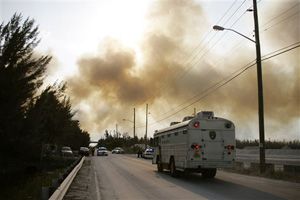
A prison double-decker approaches a road block leading to the Metro Westward Detention Center in Miami Mon, April 28,2008 as a wild fire nears the prison and heavy smoke hangs overhead. (AP Photo/J. Pat Carter)
These figures are sobering and should provide suspension to remind officers and supervisors that transporting a prisoner tin pose a risk of impairment to the officer and the prisoner. Hence, post-obit safety guidelines, policy, and preparation are disquisitional for performing this consignment without incident.
While training in safe methods for performing a send is important and regular grooming in transportation procedures in maximizing officer rubber should be ongoing, it is also important for offices and supervisors to be cognizant of the liability issues which sally from transporting prisoners.
Liability concerns on the topic are rarely discussed despite the potential of a lawsuit being filed regarding some aspect of transporting a prisoner, for instance, a civil lawsuit could be filed by a prisoner challenge an injury sustained during the transport.
An estate of a deceased prisoner may file a lawsuit against the department for the wrongful expiry of a prisoner during transport, or a lawsuit may be filed past a citizen who was harmed or killed due to a prisoner escape during the send. Some federal courts have held that the transporting department is liable a prisoner's beliefs during an escape from a transport or incurring an injury sustained during the transport.
Similar an elephant in the room, liability issues are seldom discussed despite their potential to escalate into a lawsuit. Today, I'll walk yous through aspects of prisoner transport that are vulnerable to liability -- so that your department can be in the best defensible position.
Potential liability & prisoner send
Police and corrections officers perform prisoner transport thousands of times daily across the nation for a variety of purposes. Equally previously mentioned, a majority of these transports occur without incident, only due to the unpredictable nature of the send, anything may occur and officers and supervisors should be prepared to reduce the risks when performing the duty. The former aphorism that desperate people volition do desperate things applies to a case that I worked on 2 years agone and provides an instructive instance.
The post-obit business relationship was taken from the transcripts of an interview that the arrestee provided to a psychiatrist prior to his trial:
An arrested murderer was existence transported to the canton jail by two deputies. The prisoner was handcuffed with both hands secured in the front position; he was placed in the back seat of the patrol car. There was a plastic partition separating the front and back seats. During transport, the prisoner reported, he worked up the nervus to attempt and kill himself by causing the patrol car to crash — a drastic measure out taken to avoid being sentenced to life in prison house.
(AP Photo/Thomas Babb)
He knew the officers wouldn't be injured considering they were belted, and air bags would deploy.
Claiming that he was cold, the prisoner asked the deputy to open the sliding partition so more estrus could get to the back. 1 of the deputies obliged. Equally the patrol car proceeded effectually a bend, the prisoner shoved himself through the opening of the division, grabbed the steering wheel and turned it forcefully, hoping to land the vehicle in a ditch.
He subsequently said he wanted to be projected through the windshield, hoping information technology would impale him.
But this is not what happened.
The deputy who was driving got the car under control and brought it safely to a terminate on the shoulder of the roadway. A fight ensued between the 2 deputies and the prisoner, and he was finally subdued with pepper spray. Backup officers responded and the prisoner was transported to the jail, where he'southward serving that the life judgement he went to such extraordinary measures to avoid. He also failed to prevail on a civil claim that the officers used excessive force in stopping his suicide.
This case provides an example of the mindset of many criminals and should remind officers to follow standard handcuffing procedures, fairly monitor the prisoner, and exist prepared for the unexpected. Simple requests tin turn ugly quickly.
Mini-risk direction
Performing a mini-risk management cess of the components involved in performing a prisoner ship can yield a number of general topics and can aid in identifying the risks associated with performing the task.
Consider the following major items involved in virtually every prisoner transport: selection and preparation of the vehicle; possible vehicle accidents; securing and placement of the prisoner in the vehicle; acquiring prisoner data; transporting special needs prisoners; gender of the prisoner; restraint equipment used; searching the prisoner; the number of prisoners to ship; nature of the transportation; altitude and route of the transportation; medical purposes of the transportation; using commercial shipping; officer weapons involved; number of officers required for the transport; and communications required during the send.
While not exhaustive, these components tin emerge as potential topics in which civil liability may event. Along with other components they should at a minimum be used to design policy guidelines, to provide grooming, and to review case decisions to learn how the courts examine prisoner allegations.
What case law tells us
A review of the relevant ceremonious case law regarding prisoner transport reveals a number of judicial decisions regarding the above cited areas. Among these areas of potential civil liability, the utilise or misuse of restraints, the failure to utilize seatbelts, and transporting prisoners for medical purposes emerge every bit among the more common topics in which litigation is filed. Due to the page limitations for this article simply a few cases will be discussed.
A prisoner may file a civil lawsuit under Section 1983 for declared violations of their constitutional rights and the legal statement applied in the lawsuit is determined past the status of the prisoner. For example, an arrested person injured during a transport afterwards an abort by a law enforcement officer may claim a Fourth Amendment right violation for the misuse of restraints, excessive use of force, and a failure to provide medical care under the Fourteenth Amendment.
Prisoners detained in a jail and injured during a send from the jail to courtroom or a medical intendance facility (or other destinations) generally criminate a Fourteenth Subpoena violation, while some federal courts have allowed jail prisoners to file a merits under the Eighth Subpoena.
Bedevilled prisoners, however, may file a lawsuit regarding a transport issue consistent with the Eighth Amendment, due to their convicted status. Typically the prisoner volition also claim that administrators failed to train, failed to supervise the transporting officer (south), and failed to direct officers through policies and/or the department implemented constitutional deficient policies.
What about seatbelts?
Many transportation policies direct officers to use the vehicle seatbelt when transporting a prisoner. A common complaint raised in a prisoner transport lawsuit emerges when a prisoner is injured and an officeholder failed to secure him with a seatbelt. In Brown five. Missouri Dept. of Corrections (8th Cir. 2004) a country prisoner was allegedly injured from an accident while en route to a correctional facility.
He claimed that the officers were liable for denying post-blow intendance and for providing inadequate medical care. He also claimed that the officers refused to seatbelt him into the vehicle and argued that his injuries were sustained due to a failure to be seat belted. The appellate courtroom overturned the lower court's decision, holding that the prisoner stated a valid Section 1983 claim. The court ruled that the prisoner's claims aligned with the deliberate indifference standard commenting that he had a right to condom and to medical care.
Compare however, the court's determination in Carrasquillo v. City of New York (Due south.D.N.Y. 2004).
A city prisoner brought a Section 1983 action confronting the City after he was injured in a bus blow while being transported to court. The prisoner claimed that he sustained injury as the officers failed to provide him a seat chugalug in the send bus while he was secured in handcuffs. The prisoner claimed that he could hardly back up himself and that he was denied adequate treatment.
The courtroom dismissed the prisoner'south complaint holding that the city did not violate the prisoner'southward constitutional rights past failing to provide him with a seatbelt while transporting him in handcuffs. Further, in Spencer five. Knapheide Truck Equipment Company (8th Cir. 1999) a pretrial detainee who had suffered injuries rendering him quadriplegic after he was placed with handcuffs behind his back in police transport vehicle, and was thrown forward into the bulkhead of the passenger compartment, brought a Section 1983 action against city officials.
The appellate court affirmed the lower courtroom's conclusion to grant summary judgment in favor of the officers, stating that neither the purchase of vehicles without safety restraints, nor the manner of transporting arrestees in the vehicles, showed deliberate indifference to the rights of the pretrial detainee.
Modified restraints
By and large restraint equipment used past officers in a prisoner send include: handcuffs; cuffs with waist chains and the blackbox; leg restraints; leg straps; flex-cuffs; and in some cases leg braces. The courts recognize the need, the practice and the policy of using varying types of restraints when controlling and transporting prisoners to ensure the safety of the officer and the prisoner.
For case, in Thielman v. Leean (seventh Cir. 2002) a land prisoner brought a Section 1983 action seeking injunctive relief, alleging that the department'due south policy on transporting prisoners in total restraints violated his due process and equal protection rights under the Fourteenth Amendment. The prisoner was classified every bit a sexually violent offender and complained that the policy discriminated against him, as mentally ill prisoners were not transported in full restraints when being transported from the facility.
The prisoner had a medical problem requiring him to be transported exterior of the facility for handling 3 times a month. The appeals court affirmed the lower courts decision past holding that a policy stipulating that prisoners will be secured in total and double-locked restraints, waist-chugalug chain restraints with attached handcuffs, security Blackbox, and leg restraints, did not violate the prisoner's rights to equal protection.
But when an officeholder misuses restraints, liability will more than likely be incurred.
In Mladek v. Day (K.D. GA, 2003) an arrestee brought a Department 1983 action against county officials alleging they violated his Fourth, Eighth, and Fourteenth Amendment rights when they used excessive force during and later on his arrest, during ship to the jail and denied him medical intendance. The court determined that arrestee stated a valid claim finding that a deputy violently handcuffed the arrestee with no justification and such caused concrete injury to the arrestee in violation of his Fourth Amendment rights.
Implications
This brief review provides a reminder that officers must stay diligent to their safe when performing the frequent task of transporting a prisoner. The statistics discussed at the beginning are reminders that a major problem associated with the transportation of prisoners is the potential for escape and that officer and prisoners may sustain an injury. The example example also provides a teaching point that officers need to be prepared for the unexpected during a prisoner ship and provides insight into the criminal mindset. The incident could be used as example report at a briefing or in a training setting to discuss the hazards that may be experienced in transporting prisoners.
Further, the case decisions presented also provide illustrations that prisoners take filed legal deportment stemming from transportation incidents and that seatbelts and the employ of restraints are mutual areas where lawsuits are focused. This should straight officers in ensuring that transportation guidelines are followed and that all restraint equipment is accordingly applied.
Like other chore assignments, conducting a periodic take a chance assessment of the varying dimensions of performing prisoner transports in recommended. Breaking all of the tasks down to their lowest grade is suggested and so that all components of the task are identified to permit for a complete assessment. Once the components are identified, a thorough and detailed policy tin exist developed or revised that incorporates each component. Performing such an assessment and providing a detailed policy can assist in ensuring officers are properly directed in the performance of the assignment past section administrators.
Training of all officers should follow after the policy is developed. All components of the policy should be addressed in grooming. Officers should strive to enhance their own rubber by adhering to policy guidelines and their training. Finally proper implementation of the policy and training should exist addressed in the field by supervisors to ensure officers are following the training adequately. Post-obit these few recommendations can place the section in a more defensible position should a prisoner file a lawsuit resulting from a prisoner ship.
About the writer
Dr. Ross is one of 12 Pressure Point Control Tactics (PPCT) Advisory Board Members and is the Director of Research for PPCT. He was awarded the "Excellence in Leadership Award" by PPCT in 2000. He regularly certifies police, corrections, the military and private security personnel as instructors in these subject field control tactics nationally and internationally. He has adult xv managerial and vii line officer grooming programs, has made 12 training videos, and has been authorized to provide preparation in 12 states. Dr. Ross is an author of multiple books including "Ceremonious Liability Issues in Corrections," "Civil Liability in Criminal Justice, quaternary Ed." and "Sudden Death in Custody".
Contact Darrell Ross
schaafdowinesed1987.blogspot.com
Source: https://www.corrections1.com/products/vehicle-equipment/prisoner-transport/articles/prisoner-transports-officer-safety-liability-issues-iAmg2mWlQcmOoJh8/
0 Response to "On the Road Again: the Dangers of Transporting Ailing Inmates"
Post a Comment